





Most wig caps are built from wefts: strips of hair sewn onto a base in rows. It is fast, strong and cheap, and it works. The limitation is that the hair leaves the cap in a fixed direction determined by the row, which is why wefted hair tends to move as a sheet rather than as individual strands.
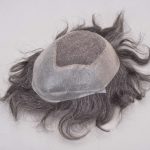
Monofilament construction solves that differently. A fine, sheer mesh is used as the base, usually at the crown or across the whole top, and individual strands are hand tied through it one at a time. Because each strand is knotted independently, it can move in any direction.
What that actually gets you
Parting anywhere within the mono section. The hair is not committed to a row, so you can move a part left, right or center without exposing a track underneath.
A scalp that reads as scalp. The mesh is sheer enough that your own skin tone shows through between the knots. That is the visual trick: you are not looking at a printed scalp, you are looking through fabric at skin.
Movement. Hair falls from a point rather than a line. In motion, at the crown, this is a much bigger difference than photographs suggest.
Why it keeps coming up for sensitive scalps
The second reason monofilament gets recommended has nothing to do with looks. A hand-tied mono top has no weft seams sitting against the head. Wefts are sewn stacks of hair with a thickened, sometimes stiff edge, and those edges rest directly on the scalp.
For a scalp with hair on it, that is usually a nonissue. For a scalp that is bare, thinned, tender or recovering, the difference is easy to feel. The National Cancer Institute’s guidance on hair loss during cancer treatment is relevant here: it recommends avoiding products such as gels or clips that may hurt the scalp, using a soft-bristled brush or wide-tooth comb, and treating an itchy or tender scalp gently. Anyone following that advice is going to notice a cap seam.
To be clear about what the evidence does and does not say: there is no clinical trial comparing monofilament caps to wefted caps. What exists is a well-established principle about gentle handling of sensitive scalp skin, plus the plain physical fact that a mono top has fewer hard edges. That is a reasonable basis for a preference, not a medical claim. If your scalp is irritated, painful or broken, that is a conversation for a dermatologist or your oncology care team before it is a shopping decision.
The breathability tradeoff nobody mentions in the ad copy
Monofilament mesh is fine and sheer, but it is a continuous sheet across the area it covers. A traditional open wefted cap has actual gaps between rows. Depending on the specific construction, a full mono top can sit closer to the scalp with less open air than an open-weft cap, and some wearers find it warmer rather than cooler.
Sustained coverage matters because occlusion changes skin behavior. Research on controlling skin hydration with occluding films notes that occlusion raises stratum corneum hydration, that this increases the permeability of the stratum corneum to water and other small molecules, and that occlusion can influence skin biology, skin pH and wound healing. Practically, a scalp kept damp and warm under any cap for many hours is a scalp more prone to itch and irritation, and that applies to every cap type rather than to mono specifically.
Manufacturers respond to this with hybrid builds: a mono crown or mono part combined with an open wefted back and sides. For most people that combination is the better answer than a full mono cap.
Cost, and when it is worth it
Hand tying is slow, so monofilament sections raise the price. A mono part is a modest premium. A full mono top is a larger one. Full hand tied throughout is a different price bracket entirely.
Worth it if: you have little or no hair underneath, your scalp is tender or reactive, you want to move your part, or you wear the unit for long daily stretches and comfort is the deciding factor.
Probably not worth it if: you wear a fixed style with a fixed part, you have your own hair underneath acting as a buffer, or you wear the unit occasionally. In those cases a good open-weft cap does the job for considerably less.