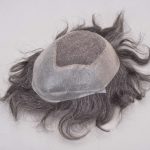




A blend wig is exactly what it sounds like: human hair and synthetic fiber tied into the same cap. Common ratios run somewhere between 30 and 70 percent human hair, though the number printed on the box is often approximate and rarely independently checked. The pitch is straightforward. You get some of the movement and realism of human hair, some of the style memory of synthetic, and a price between the two.
That pitch is real. So is the tradeoff behind it, and the tradeoff is the part most buyers do not hear until month four.
What the synthetic fraction is doing
Synthetic wig fiber is a drawn plastic filament. The curl or wave is set into it thermally during manufacture, and the fiber holds that shape because the polymer was cooled into it. Wash it, sleep on it, walk through rain, and it snaps back to its molded state. Human hair does not do this. Human hair takes whatever shape you last dried it into, which is why an all-human-hair wig requires actual styling every time it gets wet.
In a blend, the synthetic fraction acts as a skeleton. It keeps the overall shape recognizable so that the human hair drying around it lands roughly where it should. For someone who wants a wave pattern to survive a workday without a round brush, that is genuinely useful.
The problem: two materials, two failure modes
Human hair and synthetic fiber respond to heat by completely different mechanisms, and this is where blends get difficult.
Hair is keratin protein. When it is heated, it changes chemically. Researchers using confocal Raman spectroscopy to measure thermal stress on human hair fibers applied a straightening iron at 235 degrees Celsius in short cycles and found a measurable drop in alpha helix keratin structure, a rise in beta sheet formation, and reduced intensity in the covalent cysteine crosslink bands. Those are structural changes to the protein, and they accumulate rather than reverse.
Synthetic fiber is thermoplastic. It does not denature; it softens, deforms and can fuse. Standard synthetic fiber typically fails at temperatures far below what human hair tolerates, which is why heat-friendly formulations exist as a separate product category at all. The result inside a blend is that any iron temperature is a compromise. Set it low enough to protect the synthetic and the human hair barely responds. Set it high enough to actually style the human hair and you risk melting or frizzing the synthetic permanently, which cannot be repaired.
Aging at different rates
The same split shows up over time. Human hair thins and gets drier as the cuticle wears. Synthetic fiber develops surface abrasion and tangles at friction points, most visibly at the nape. Because the two materials degrade differently, a blend often reaches a point where the human hair still looks acceptable but the synthetic has gone dull and matted, or the reverse. You end up retiring the whole unit because one half of it failed.
Care compromises follow from this:
- Cool or lukewarm water only, since heat that helps human hair is a liability for the synthetic.
- No coloring. Dye chemistry acts on hair and simply does not take on synthetic filament, so you get a two-tone result.
- Air drying on a stand rather than blow drying, in most cases.
- Low or no direct heat styling unless the seller specifically states the synthetic portion is heat-friendly and gives a maximum temperature.
Who a blend genuinely suits
Blends work well for people who want a set style they will not change, who need it to survive weather and a full day without restyling, and who accept a lifespan shorter than a comparable human hair unit. They also make sense as a second or third wig in a rotation, where lighter use extends the life of everything.
Blends work poorly for people who want to color, cut into a new shape, or heat style regularly, and for anyone expecting several years of daily wear.
One last practical note. If the fiber ratio matters to your decision, ask for it in writing. The federal fiber labeling rule at 16 CFR Part 303 requires generic fiber names and percentages by weight in order of predominance for covered textile products, and wigs are not among the articles it excludes. Enforcement in this market is thin, but a seller willing to state a specific ratio in writing is behaving differently from one who says “blend” and moves on.